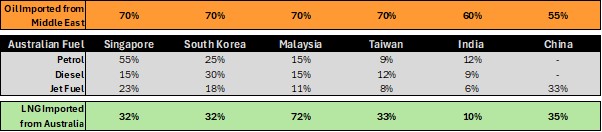
Australia relies on a relatively small number of regional partners to meet most of its refined fuel needs, while those same partners depend on Australia for a significant portion of their LNG supply. This mutual dependence strengthens trade relationships but also highlights the interconnected nature of regional energy security, particularly in times of geopolitical disruption.
Fuel Security
The Prime Minister is engaging with key regional partners, including Singapore, to leverage Australia’s broader energy relationships and support continuity of fuel supply. While Australia is a major exporter of LNG to Asia, it remains reliant on imported refined fuels. A significant proportion of crude oil processed by Australia’s Asian refining partners is sourced from the Middle East, creating ongoing exposure to disruption arising from the conflict.
Local Fuel Shortages
Strong global demand is expected to sustain elevated fuel prices. At the same time, supply to Asian markets may be constrained by the fallout from the conflict, increasing competition for available volumes. This is likely to place upward pressure on prices and heighten the risk of localised shortages as countries seek to secure uncontracted fuel supply to maintain national reserves.
Economic Impact
As higher fuel costs flow through global supply chains, broader economic impacts are expected, including increased prices for goods and services, rising inflation and unemployment, and pressure on economic growth. In a sustained disruption scenario, there is a risk of conditions emerging that resemble aspects of the economic challenges experienced during the oil shocks of the 1970s.
0 Comments