This Briefing Note accompanies the Fuel Risk & Financial Impact: What Councils Need to Know Now Council Information Session held online on 8th April 2026 by the CT Management Group and Uniqco.
Purpose
The purpose of this Briefing Note to Council Executives is to:
- outline the risks associated with escalating fuel costs and possible fuel supply disruption; and
- recommend immediate, short and medium-term actions to maintain service continuity and financial stability.
Councils need to consider their response to this fuel crisis in the context of business continuity – providing essential services to their communities. Failing to provide some of the essential services may adversely impact public health, wellbeing and safety.
PM’s National Address
The present fuel crisis driven by the Middle East conflict caused the PM to deliver a rare national address, during which he announced immediate relief measures, including a 26-cent-per-litre reduction in fuel excise for three months and a temporary elimination of the heavy vehicle road user charge. He urged consumers to avoid panic buying and recommended working from home where possible and using public transport to conserve fuel. Importantly, he emphasised there was no immediate need for fuel rationing, with the response deliberately avoiding COVID-style restrictions or broader emergency interventions.
National Campaign
Following the PM’s National Address, the Australian government released the “Every little bit helps” advertising campaign to encourage motorists to reduce fuel consumption during a global supply crisis by reducing car usage, optimizing driving habits, and improving vehicle efficiency. The campaign supports the four-stage National Fuel Security Plan (currently at level two) to manage rising prices.
The key points of the “Every Little Bit Helps” Campaign:
- Behavioural Change: Motorists are urged to drive less, use public transport, walk, cycle, or carpool, and combine errands into fewer trips.
- Driving Efficiency: Advice includes reducing unnecessary acceleration, avoiding heavy braking, minimizing idling, and closing windows at high speeds.
- Vehicle Maintenance: Drivers are advised to keep tyres properly inflated and remove unnecessary weight (e.g., roof racks) to improve fuel efficiency.
- Responsible Purchasing: Motorists are urged to “only fill what you need” and avoid panic buying.
- Strategic Context: The campaign informs the public about the National Fuel Security Plan, specifically Level 2 (“keeping Australia moving”).
The campaign is featured across television, radio, digital, and outdoor advertising, following supply pressures linked to the Middle East conflict.
Introduction and Background
The head of the International Energy Agency recently said Asia is at the forefront of the current oil crisis. IEA described the current circumstances as “the largest supply disruption in the history of the global oil market” including the oil shocks of the 70s. The impacts were profound, reshaping economies, policy frameworks, and energy systems across the developed world. If current conflicts continue to significantly damage oil production infrastructure, the short-term impacts would be supply constraints, price spikes and inflationary pressure, which would echo what happened in the 1970s.

While the Commonwealth Government has been running the line that we do not have a supply problem, there have been as many as six shipments of fuel that have been cancelled and replaced. The Commonwealth Government is actively leveraging its regional energy relationships to secure additional fuel shipments to maintain supply continuity. Australia’s position as a net energy exporter does not eliminate its exposure to fuel supply risk, given its reliance on imported refined petroleum products. This reinforces the importance of managing supply chain reliability, not just aggregate energy availability.
The Commonwealth’s position typically reflects aggregate supply availability. Australia remains integrated into global fuel markets, with access to imports, domestic refining capacity (albeit reduced), and strategic reserves through mechanisms such as the International Energy Agency obligations. On paper, this means there is no systemic shortage of fuel.
Over 600 service stations around the country have run out of at least one fuel at different times.
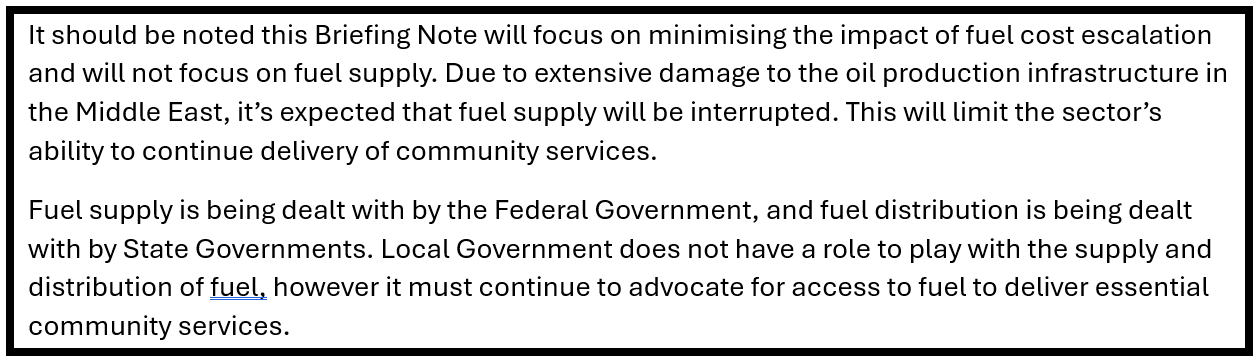
Councils are not exposed to global supply but are exposed to last-mile availability and distribution. A council can however face real operational disruption even when national supply is technically available and adequate.
Context
Global instability and conflict in the Middle East is placing increasing pressure on oil production and distribution networks, heightening the risk of supply chain disruption and sustained price volatility. While global supply may remain broadly adequate, emerging constraints within logistics, refining capacity and shipping are reducing system resilience, increasing the likelihood of delayed deliveries, localised shortages, and upward pressure on fuel prices.
Even small to medium councils typically spend in excess of $1 million annually on fuel ($20,000 per week), with exposure embedded across fleet operations, plant, waste services and contractor-delivered activities.
Since the onset of the conflict, petrol prices have increased by approximately 20–40%, with diesel experiencing even sharper and more volatile increases. National average retail prices for regular unleaded petrol in Australia reached an unprecedented $2.38 per litre by late March, representing a 27% increase since the start of the conflict. While the Commonwealth’s decision to halve the fuel excise has delivered short-term relief of around 26 cents per litre, early evidence suggests this benefit is already being eroded by ongoing global supply pressures and price escalation.
Fuel is a critical input to essential services including waste collection, road maintenance, emergency response, and statutory compliance activities. Disruptions to supply or rapid cost escalation present a direct risk to service delivery and council’s financial performance.
While national fuel supply remains adequate, recent postponements of multiple fuel shipments indicate increasing stress within global and regional supply chains. These disruptions reduce system resilience and increase the likelihood of localised shortages and further price volatility. Councils should therefore adopt a precautionary approach, recognising that service delivery risk arises from access and timing of supply, not just total national availability.
Regional councils are facing greater volatility and higher prices due to supply constraints and higher transport costs, placing added pressure on their budgets compared to metropolitan counterparts.
Key Risks
The key risks to councils would present themselves as:

Immediate Actions for Councils
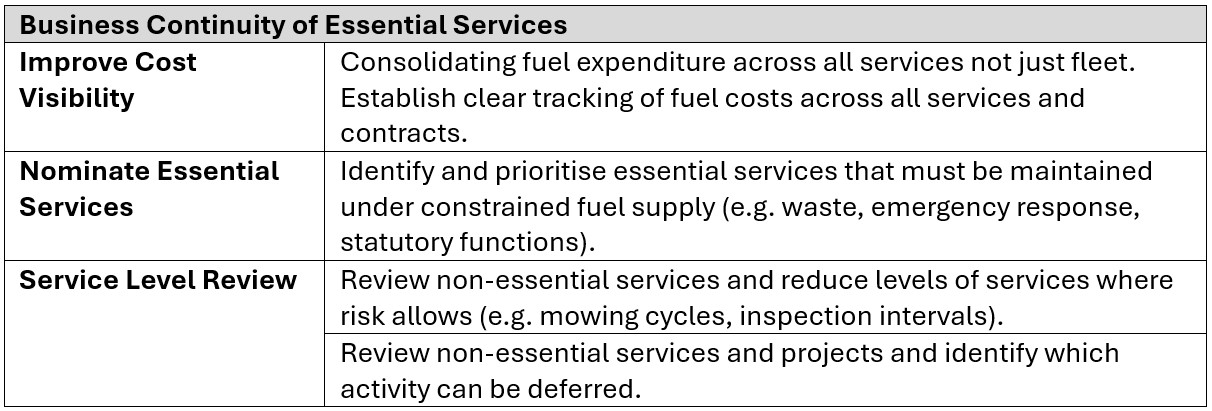
These steps will enable councils to have visibility over impact of fuel escalation on budget. This will enable councils to take required governance actions to facilitate budget over-expenditure. These steps will also focus the council’s service delivery on essential community services, thereby limiting ongoing exposure to spiking fuel prices.
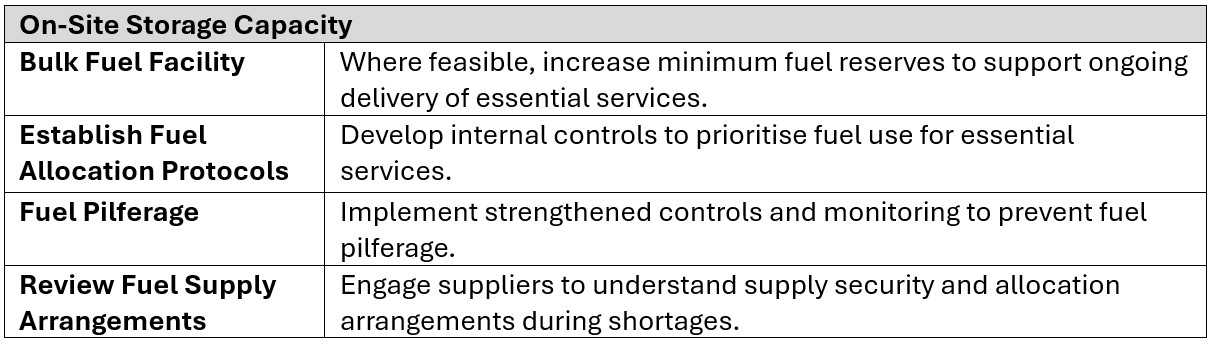
While councils with on-site bulk fuel storage have some additional operational flexibility, these reserves are typically limited relative to daily consumption. In a constrained supply environment, councils should prioritise the use of bulk fuel facilities to support the ongoing delivery of essential services.
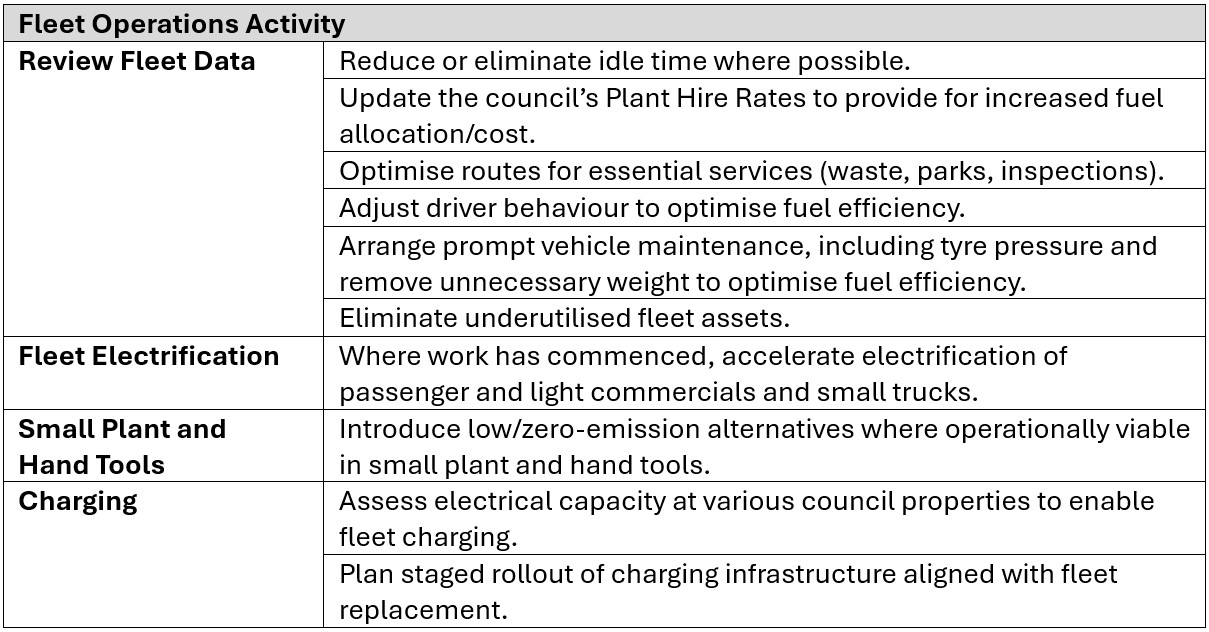
These steps will ensure the council’s fleet are performing efficiently and using only the fuel they need. Where councils have committed to electrification of their fleet, this may be an opportune time to progress some of the work to enable this to take place.

Councils are exposed to spiking fuel prices directly through fleet usage as well as various contracts where fuel is material to the contracted service delivery. These steps will ensure councils understand the direct and indirect impact of fuel price escalation and ready contracts for the future.
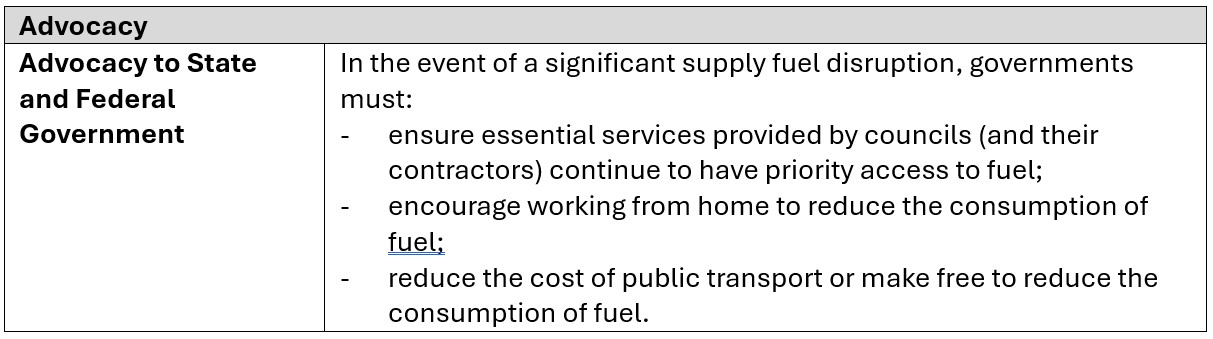
Councils should work with their local government associations and local parliamentary members to ensure they have ongoing access to fuel to enable delivery of essential community services.
Governance
Fuel risk should be managed as a whole-of-council issue. Councils should look to establish a cross-functional working group (Fleet, Finance, Procurement, Operations) with clear accountability for implementation and monitoring.
The central economic outlook is based on relatively optimistic assumptions, namely that the Strait of Hormuz reopens within two months and that global oil supply returns to pre-conflict levels by year end.
Conclusion
Under this scenario, forecasts suggest inflation could rise to around 6%, with unemployment increasing to approximately 5%.
However, given the continued escalation in rhetoric and the absence of any de-escalation, there is a material risk that these assumptions do not hold, with the potential for significantly worse economic outcomes.
Fuel supply disruption and price volatility present a material and immediate risk to council operations. Proactive management through prioritisation, demand reduction, financial planning, and transition to alternative energy sources will strengthen service resilience and reduce long-term exposure.
0 Comments