Briefing Note
Purpose
The purpose of this briefing note is to inform Council executives of the emerging financial, operational and reputational risks associated with continued procurement of internal combustion engine (ICE) fleet assets in the context of declared emissions targets (particularly 2030), and to outline recommended strategic responses.
Councils Leading the Way
The adoption of emissions reduction targets at national and international levels (most notably under the Paris Agreement) provided a strong policy signal that cascaded through all levels of government, including local government. In response, many Australian councils moved quickly to position themselves as leaders in climate action.
This period, particularly from the mid-2010s onward, was characterised by a sense of urgency and leadership ambition. Councils across metropolitan and regional Australia formally declared climate emergencies, signalling both the scale of the challenge and their intent to act decisively. These declarations were often accompanied by commitments to achieve net-zero emissions across council operations, and in some cases, across their broader communities.
Several capital city councils (including City of Melbourne, City of Sydney and City of Adelaide) went further, achieving or declaring carbon neutrality more than a decade ago. These early adopters typically pursued a combination of:
- large-scale renewable energy procurement (including power purchase agreements),
- energy efficiency upgrades across buildings and infrastructure, and
- purchase of carbon offsets to neutralise residual emissions.
This early wave of activity was often policy-led, driven by alignment with international commitments and supported by strong community expectations, particularly in metropolitan areas. However, it is also important to recognise that many of these early commitments were made in a context where:
- the full cost of transition was not yet fully appreciated,
- EV technology and supporting infrastructure were still emerging, and
- reliance on carbon offsets provided a relatively accessible pathway to achieving “carbon neutral” status without fully eliminating emissions at source.
As a result, while these early actions established important leadership and momentum, they also created a legacy of commitments that councils are now required to operationalise in a more financially constrained and technically complex environment.
Carbon offsets provided a relatively accessible and flexible mechanism to neutralise residual emissions, particularly where:
- technology pathways were immature (e.g. electric utilities, trucks and plant), and
- direct abatement opportunities were limited or cost-prohibitive.
However, there is a growing shift across the sector away from reliance on offsets and toward direct, localised emissions reduction initiatives. The transition from carbon offsets to direct emissions reduction represents a significant evolution in council climate strategy. It reflects a move to more capital-intensive, locally delivered initiatives that provide tangible environmental community outcomes.
International Signals and Local Action
The 2023 re-election of President Trump in the US, his anti-climate attitude and policies such as “Drill Baby Drill”, and withdrawal from the Paris Agreement have provided political cover and emboldened some governments and political actors across the globe to revisit their climate commitments.
We’ve seen this fallout in Australia with the Nationals dropping net zero then talking their Coalition partners into doing the same, without withdrawing from the Paris Agreement, leaving the nation questioning what this actually means. Particularly in the inner-city seats now held by the Teals and so desperately missed by the Coalition.
While maintaining the state’s net-zero 2050 target, the incoming Queensland LNP government has:
- pushed out some of the short and medium-term emissions targets,
- recommitted to coal and oil exploration, and
- increased regulatory friction for renewable projects.
Global political signals and local actions have not removed the requirement for councils to transition, but they have influenced how it should be approached. Councils are now transitioning from aspirational commitments to delivery phase execution, where:
- capital investment requirements are more visible,
- operational impacts are more pronounced, and
- trade-offs between cost, service delivery and emissions reduction are more actively contested.
This shift is occurring alongside changing political and economic signals, which are reinforcing the need for:
- stronger business cases,
- clearer prioritisation frameworks, and
- more disciplined sequencing of decarbonisation initiatives.
The initial wave of council climate commitments played a critical role in establishing leadership, setting direction and building momentum. However, the sector is now entering a more mature phase, where the focus has shifted from commitment to implementation, requiring a more measured, financially sustainable and operationally grounded approach to achieving emissions reduction objectives. None of this is bad.
Fuel Shock
On the other hand, global instability and conflict in the Middle East are placing increasing pressure on oil production and distribution networks, heightening the risk of supply chain disruption and sustained price volatility. Fuel prices have reached unprecedented highs within the last month – petrol at $2.60 per litre and diesel at $3.28 per litre.
There is clear and immediate evidence of a surge in consumer interest in electric vehicles following the fuel price escalation. Searches, enquiries and financing activity have increased by over 100% in some cases, and the used-EV market has responded rapidly with rising sales and prices. While new vehicle sales are also increasing, breaking records in March, it remains early in the cycle, and current sales data does not yet fully reflect the behavioural shift. If fuel prices remain elevated, a more pronounced increase in EV uptake is likely over the next 6 to 12 months.
Background
Many Australian councils have adopted net-zero emissions targets by 2030, typically aligned to corporate (operational) emissions. Fleet assets (particularly light commercial vehicles, utilities and trucks) represent a significant proportion of their Scope 1 emissions.
At the same time, councils continue to procure ICE vehicles due to:
- limited availability of fit-for-purpose zero-emission alternatives,
- operational requirements (range, payload, towing capacity),
- infrastructure readiness constraints, and
- financial considerations, including capital cost and residual value uncertainty.
This has created a structural misalignment between fleet asset life cycles and net-zero target timeframes.
Key Issue
Fleet assets procured between 2026 and 2029 will, in many cases, remain in service beyond 2030, resulting in:
- ongoing Scope 1 emissions,
- reliance on carbon offsets to maintain net-zero status, and
- constrained ability to rapidly transition the fleet post-2030.
This creates forward emissions and cost exposure, which should be considered in current procurement decisions.
Financial Exposure
Residual emissions from ICE vehicles post-2030 will require offsetting (where councils adopt carbon neutrality frameworks such as Climate Active). Indicative impact:
- Light commercial vehicle: ~4–5 tonnes CO₂/year,
- Offset cost: ~$30–$60/tonne (subject to market conditions), and
- Annual cost per vehicle: ~$120–$300.
While modest at a single-vehicle level, this becomes material across the fleet and over time. With 100 vehicles at $200/vehicle, the carbon offset liability is $20,000 per annum. Most councils will have more than 100 vehicles. In addition, councils may face:
- rising fuel costs,
- increased whole-of-life costs compared to future zero-emission alternatives, and
- pressure on fleet reserve funding models.
Asset and Transition Risk
Ongoing ICE procurement may result in:
- stranded assets beyond 2030
- compressed replacement cycles (increasing capital pressure)
- reduced flexibility to respond to improving EV market conditions.
This risk is particularly acute for long-life assets such as trucks and specialised plant.
Strategic and Reputational Risk
There is a growing expectation that procurement decisions align with declared climate commitments. Misalignment may lead to:
- perceived inconsistency between policy and practice,
- increased scrutiny from auditors and regulators, and
- reputational impacts with community and stakeholders.
Analysis
The issue is not one of policy failure, but of transition timing. Councils are operating in a constrained market environment where:
- zero-emission alternatives are not yet fully available across all fleet categories,
- infrastructure rollout is still underway, and
- financial and operational risks must be managed prudently.
However, without deliberate intervention, councils are effectively deferring emissions reduction obligations into the post-2030 period, increasing reliance on offsets and future capital expenditure.
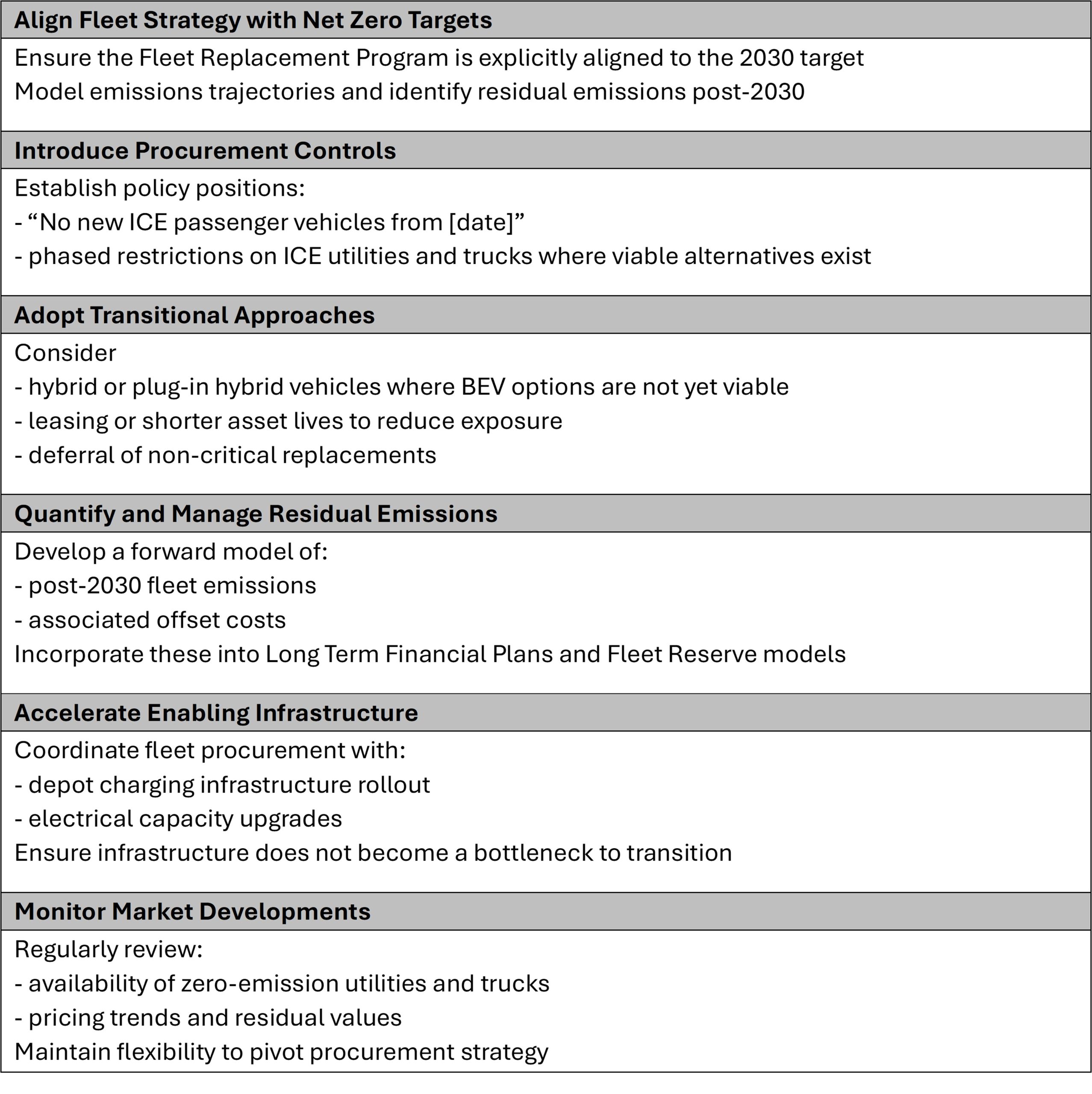
Recommended Strategic Response
Conclusion
Councils continuing to procure ICE fleet assets in the lead up to 2030 are, in effect, embedding emissions beyond their net-zero targets. This creates a future cost and transition burden, primarily in the form of carbon offsets and accelerated capital replacement.
While this reflects current market constraints, it is critical that councils recognise the exposure, quantify the impact and actively manage the transition. A structured Transition Plan will enable councils to balance operational requirements with transition to net-zero assets, financial sustainability and climate commitments.
About Us
The 2026 EV Fleet Expo for Local Government is scheduled for 9th September. It will showcase the latest developments in battery electric vehicles, plug-in hybrid electric vehicles and hybrids, with a strong focus on operational fleet applications.
This one-day event is designed specifically for fleet managers, sustainability and procurement professionals and operational staff, responsible for service delivery across local government and other similar sectors. Participants will have opportunity to:
- view and test drive passenger vehicles (pool cars under $50,000),
- explore a range of electric utilities, vans and trucks,
- engage in education sessions highlighting best practices in transition to EVs, and
- learn from experts about topics including EV battery health, charging infrastructure, maintenance requirements, whole-of-life cost analysis and residual value and more.


0 Comments