Executive Summary
This document provides councils with a practical, evidence-based framework for assessing operational requirements before committing to low-emission fleet replacements. It recognises that fleet electrification is not simply a matter of replacing internal combustion engine vehicles with electric equivalents, but a broader service delivery decision requiring careful consideration of operational suitability, fleet composition, charging infrastructure, organisational capability, whole-of-life cost and community value.
The central message is that councils should shift from a like-for-like replacement mindset to a service delivery mindset. Before selecting a vehicle or technology, councils should define the task the asset must perform, understand how the vehicle is used, assess workload predictability, and determine whether the existing asset remains the most appropriate solution. This approach can reveal opportunities to downsize, consolidate, share, substitute or defer replacement decisions, ensuring investment is directed to assets that are genuinely fit-for-purpose.
The framework outlines eight sequential steps: defining the operational requirement, understanding utilisation and workload, optimising fleet composition, selecting the most appropriate low-emission technology, developing a charging strategy, evaluating whole-of-life costs, assessing organisational capability, and monitoring performance over time. Together, these steps help councils match technology to operational need, reduce implementation risk, avoid over-specification, and build a scalable foundation for future fleet electrification.
A key principle is that different fleet roles will require different technology pathways. Battery electric vehicles are best suited to predictable workloads with known travel patterns and reliable charging opportunities. Plug-in hybrid vehicles may provide an effective transition option for mixed or variable workloads, while hybrid, hydrogen or retained internal combustion assets may remain appropriate where low-emission alternatives are not yet operationally or commercially viable.
The document also emphasises that charging infrastructure, financial assessment and organisational readiness must be planned as integrated components of fleet transition. Charging strategies should be designed around operational availability and fleet-level demand rather than individual vehicles alone. Whole-of-life cost assessments should compare acquisition, energy, maintenance, infrastructure, residual value, downtime and emissions outcomes to identify the best value-for-purpose option. Councils must also ensure they have the people, systems, governance, training and safety arrangements needed to support an increasingly electrified fleet.
Applied consistently, this methodology enables councils to make fleet decisions that are operationally sound, financially sustainable and aligned with emissions reduction objectives. It positions fleet electrification as the outcome of disciplined service planning, rather than a stand-alone procurement exercise, and provides a practical basis for discussion at the EV Fleet Expo Operational Requirements panel session.
Introduction
This section sets out a practical framework for defining operational requirements before councils commit to replacing fleet assets with low-emission alternatives. It recognises that fleet electrification is not simply a procurement exercise, but a service delivery decision that must balance operational suitability, whole-of-life cost, emissions reduction, charging infrastructure, organisational capability and long-term value for the community.
For local government, the challenge is to move beyond like-for-like vehicle replacement and instead ask what asset, technology and supporting infrastructure are required to deliver each service safely, reliably and economically. This approach enables councils to optimise fleet composition, identify where battery electric, plug-in hybrid, hybrid or other technologies are appropriate, and ensure charging strategies are designed around real operational needs rather than assumptions.
The following steps provide an evidence-based methodology for assessing each replacement decision from first principles: defining the operational requirement, understanding utilisation and workload, optimising fleet composition, selecting the most appropriate low-emission technology, developing a charging strategy, evaluating whole-of-life costs, assessing organisational capability and embedding continuous improvement. Applied consistently, this framework helps councils reduce implementation risk, direct investment to the right assets and support a sustainable transition to low-emission transport.
Step 1 – Define the Operational Requirement – Not the Replacement Vehicle
The transition to low-emission vehicles requires councils to move from a vehicle replacement mindset to a service delivery mindset.
For decades, fleet replacement has largely been based on a like-for-like approach, where an existing sedan is replaced with another sedan, a utility with another utility, or a truck with another truck. While this simplified procurement and reflected a relatively stable vehicle market, it is no longer appropriate in an environment where battery electric and plug-in hybrid vehicles offer new capabilities, operating models and opportunities to optimise fleet composition.
Rather than asking “What vehicle should replace this asset?”, councils should instead ask “What asset is required to deliver this service?” This subtle but fundamental shift changes the focus from replacing vehicles to understanding the operational task and identifying the most appropriate solution.
The assessment should begin by defining the operational requirements, including:
- the service being delivered;
- the tasks the vehicle is required to perform;
- the frequency and duration of use;
- daily and annual travel distances;
- passenger requirements;
- payload and equipment carried;
- towing requirements;
- terrain and off-road use;
- access to charging infrastructure; and
- opportunities to share, consolidate or eliminate vehicles.
This process frequently challenges long-held assumptions. A utility may be better replaced by a van where secure storage is the primary requirement. A 4WD may be replaced by a 2WD if off-road use is infrequent. A large truck may be replaced by a smaller battery electric vehicle where payload analysis shows the existing vehicle is significantly underutilised. In some cases, the analysis may even demonstrate that a vehicle is no longer required or could be shared across multiple work groups.
By shifting from a vehicle replacement mindset to a service delivery mindset, councils can optimise fleet composition before considering electrification. The objective is not simply to replace every internal combustion engine vehicle with an electric equivalent. It is to ensure the council has the right asset, in the right place, performing the right task, at the lowest whole-of-life cost. Fleet electrification then becomes the outcome of sound service planning and evidence-based decision-making, rather than the starting point.
Step 2 – Understand Vehicle Utilisation and Operational Workload
Once the operational requirement has been defined, councils need to understand how the vehicle is actually used. While utilisation data such as annual kilometres, daily travel distances and hours of operation are important, they provide only part of the picture. Councils also need to understand the nature and predictability of the vehicle’s workload, as this is a critical factor in determining the suitability of battery electric and plug-in hybrid vehicles.
Historically, fleet managers focused primarily on vehicle utilisation because refuelling an internal combustion engine vehicle was quick, widely available and rarely constrained operationally. The transition to low-emission vehicles changes this equation. Battery electric vehicles require charging to be planned around operational requirements, while plug-in hybrid vehicles deliver their greatest economic and environmental benefits when they can complete most daily travel using battery power before reverting to the internal combustion engine when necessary.
Many council vehicles support routine service delivery, where operational demands remain largely unchanged from day to day, week to week and month to month. Services such as parks maintenance, environmental inspections, local laws, community transport and scheduled maintenance typically follow predictable routes, operate within defined geographic areas and travel similar distances each day. This level of predictability makes these vehicles ideal candidates for battery electric vehicles because councils can accurately determine daily energy consumption, battery capacity requirements, charging times and charger locations. Charging can be incorporated into normal operational routines, minimising disruption while maximising electric kilometres travelled.
Conversely, vehicles supporting responsive services or capital works programs often experience far greater variation in workload. Emergency response, storm recovery, civil construction, infrastructure maintenance and project-based activities may require vehicles to travel unpredictable distances, respond to changing priorities, tow heavy equipment or operate for extended periods away from the depot. These operational characteristics make energy demand more difficult to forecast and can increase the operational risk of relying solely on battery electric vehicles. In these circumstances, plug-in hybrid vehicles may provide a practical transition pathway by enabling vehicles to operate on electricity for routine travel while retaining the flexibility of a conventional engine when operational demands exceed the available battery range.
Councils should therefore assess not only how much a vehicle is used, but also how predictable its operational requirements are. This assessment should consider:
- annual, monthly and daily kilometres travelled;
- variation in daily travel distances;
- trip frequency and average trip length;
- operating hours and idle time;
- route predictability;
- seasonal fluctuations in workload;
- payload and towing requirements;
- opportunities for overnight or workplace charging; and
- whether the vehicle supports routine scheduled services or responsive and project-based activities.
Understanding both vehicle utilisation and workload predictability provides a stronger evidence base for fleet electrification. It enables councils to identify those vehicles that are ideally suited to battery electric replacement, those better suited to plug-in hybrid technology, and those where alternative solutions or a deferred transition may be more appropriate. By matching vehicle technology to operational requirements, councils can reduce implementation risk, optimise charging infrastructure investment and ensure that fleet electrification enhances rather than constrains service delivery.
Step 3 – Optimise Fleet Composition
Having defined the operational requirement and developed a clear understanding of vehicle utilisation and workload predictability, the next step is to optimise fleet composition.
The objective is to optimise fleet composition by ensuring that every replacement decision results in the most fit-for-purpose asset being selected to perform the required operational task. Rather than replacing vehicles on a like-for-like basis, councils should evaluate a range of fleet solutions that improve service delivery, reduce whole-of-life costs and support the transition to low-emission transport.
This assessment should consider whether the existing vehicle remains the most appropriate solution or whether an alternative approach would better meet operational needs. Opportunities may include:
- replacing a larger vehicle with a smaller, more appropriately specified asset;
- substituting a utility with a van where secure storage and equipment protection are the primary operational requirements;
- replacing a 4WD with a 2WD where off-road capability is only occasionally required;
- downsizing trucks where payload analysis demonstrates the existing vehicle is consistently underutilised;
- consolidating vehicles where utilisation is low or workloads can be shared across work groups;
- introducing pool vehicles or shared fleet arrangements;
- hiring specialist vehicles for infrequent or highly specialised tasks rather than maintaining ownership; or
- retaining the existing vehicle where replacement cannot yet be justified on operational or economic grounds.
The assessment should also recognise that the objective is not simply to reduce fleet size or select the lowest-cost asset. The primary objective is to ensure that each asset is appropriately matched to the service it supports. A well-specified fleet improves operational efficiency, enhances service delivery, reduces capital and operating costs, and creates greater opportunities to introduce low-emission technologies.
By optimising fleet composition before selecting a replacement vehicle, councils establish a stronger foundation for fleet electrification. This ensures investment is directed towards the right assets, reduces the risk of over-specification, and enables charging infrastructure and future fleet planning to be aligned with genuine operational requirements rather than historical fleet composition.
Step 4 – Select the Most Appropriate Low-Emission Technology
Having determined the optimum fleet composition, the next step is to select the propulsion technology that best supports the operational requirements of each asset.
The objective is to select the lowest-emission technology capable of delivering the required service safely, reliably and economically throughout the asset’s whole-of-life. Technology selection should be evidence-based and reflect the operational analysis undertaken in the preceding steps rather than organisational preference or the availability of a particular vehicle model.
Councils should evaluate the technologies currently available, including:
Battery Electric Vehicles (BEVs) – best suited to vehicles with predictable workloads, known daily travel distances, established charging opportunities and limited towing or payload requirements.
Plug-in Hybrid Electric Vehicles (PHEVs) – well suited to vehicles with mixed operational demands where most daily travel can be completed using battery power, while retaining the flexibility of an internal combustion engine for longer journeys, towing or variable workloads.
Hybrid Electric Vehicles (HEVs) – appropriate where battery electric or plug-in hybrid alternatives are not yet operationally or commercially viable but reductions in fuel consumption and emissions can still be achieved.
Hydrogen Fuel Cell Vehicles – where commercially available and appropriate, particularly for applications requiring extended operating hours, long range or heavy-duty capability.
Technology selection should consider:

Councils should recognise that different technologies may be appropriate for different parts of the fleet. Passenger vehicles may transition directly to battery electric vehicles, while operational utilities, trucks and specialist plant may require plug-in hybrid, hybrid or alternative technologies until battery electric capability matures further.
Selecting the appropriate technology is not about identifying a single solution for the entire fleet. It is about matching the most appropriate technology to each operational requirement, enabling councils to maximise emissions reduction while maintaining service delivery, managing risk and achieving value for money.
Step 5 – Develop the Charging Strategy
Once the most appropriate low-emission technology has been selected, councils should develop a charging strategy that supports operational requirements while minimising infrastructure investment and operating costs.
The objective is to ensure that charging infrastructure enables service delivery rather than dictates it. Charging solutions should be designed around the operational characteristics of the fleet identified in the preceding steps, recognising that different vehicle types and operational roles may require different charging arrangements.
Councils should first determine where and when vehicles are available for charging. This assessment should consider:
- whether vehicles return to the depot each day;
- the length of time vehicles remain parked between shifts;
- opportunities for overnight charging;
- workplace charging during the day;
- destination charging at council facilities or frequently visited locations;
- home charging arrangements where appropriate;
- the availability and reliability of public charging infrastructure; and
- future changes in fleet size and vehicle technology.
The charging strategy should also reflect the operational profile of each vehicle. Assets performing predictable daily duties with overnight depot parking may only require relatively low-cost AC charging, while vehicles with higher energy demand or multiple daily shifts may require faster charging solutions or different operational arrangements.
Importantly, charging infrastructure should be planned at a fleet level rather than on a vehicle-by-vehicle basis. This enables councils to optimise charger numbers, charger types, electrical capacity, energy management systems and future expansion, reducing both capital costs and long-term operating expenditure.
Charging infrastructure should therefore be viewed as an integral component of fleet planning, not a separate engineering project. By aligning charging with operational requirements, councils can maximise vehicle availability, minimise infrastructure costs and establish a scalable foundation for future fleet electrification.
Step 6 – Evaluate Whole-of-Life Costs and Select the Preferred Option
Having identified one or more operationally suitable fleet solutions, councils should undertake a comprehensive whole-of-life cost (WoLC) assessment before making a procurement decision.
The objective is to identify the option that delivers the best long-term value while meeting operational requirements and supporting the council’s emissions reduction objectives. Procurement decisions should not be based solely on purchase price, as this may result in higher operating costs and a less efficient fleet over the asset’s life.
The WoLC assessment should compare each viable option based on:
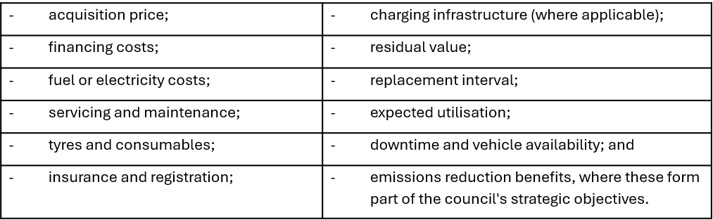
The preferred fleet solution should not necessarily be the lowest-cost option, nor the asset with the lowest purchase price. It should be the option that represents the best value-for-purpose—delivering the required level of service, meeting operational requirements, supporting the council’s emissions reduction objectives and providing the lowest practical whole-of-life cost. By balancing operational performance, financial sustainability and environmental outcomes, councils can ensure every fleet investment delivers the greatest long-term value to the community.
Step 7 – Assess Organisational Capability
Selecting the right fleet solution is only part of a successful transition to low-emission transport. Councils must also ensure they have the organisational capability to implement, operate and support the new fleet safely, efficiently and sustainably.
The objective of this step is to confirm that the organisation has the people, systems, infrastructure and governance necessary to support the transition. Identifying capability gaps before vehicles are procured reduces implementation risk and enables councils to plan supporting investments in a coordinated manner.
The assessment should consider whether the council has the capability to support:
- charging infrastructure and electrical capacity;
- energy management and charging operations;
- fleet management systems and data integration;
- workshop facilities and maintenance arrangements;
- servicing and manufacturer support;
- driver training and change management;
- high-voltage safety procedures and emergency response;
- fleet, charging and workplace policies;
- procurement and contract management capability;
- budgeting and long-term financial planning; and
- organisational governance, reporting and performance monitoring.
Councils should also recognise that the transition to low-emission transport is likely to influence a range of business functions beyond fleet management, including asset management, facilities management, engineering, finance, information technology, procurement and workplace health and safety. Early collaboration across these functions will improve planning, reduce implementation risks and support a more coordinated transition.
By assessing organisational capability before implementation, councils can ensure they are not only procuring the right assets but also establishing the systems, governance and organisational capacity needed to operate and manage an increasingly electrified fleet over the long term.
Step 8 – Monitor, Evaluate and Continuously Improve
The transition to low-emission transport does not end when a vehicle is delivered. Councils should continually monitor fleet performance to confirm that replacement decisions are delivering the expected operational, financial and environmental outcomes and to identify opportunities for further improvement.
The objective of this step is to evaluate whether the selected fleet solution has proven to be both fit-for-purpose and value-for-purpose, while building an evidence base to support future fleet planning and procurement decisions.
Performance monitoring should consider:
- vehicle utilisation and workload;
- energy consumption and charging patterns;
- operating and maintenance costs;
- vehicle reliability and availability;
- driver and operational staff feedback;
- emissions reduction and environmental performance;
- service delivery outcomes;
- charging infrastructure performance and utilisation; and
- whole-of-life cost assumptions compared with actual performance.
Councils should regularly review whether the asset continues to meet operational requirements or whether changing service demands create opportunities to further optimise fleet composition. Lessons learned from vehicle performance, operational experience and technological developments should be incorporated into future fleet replacement programs, ensuring that procurement decisions become progressively more informed and evidence-based.
By embedding continuous monitoring and evaluation into fleet management, councils create a cycle of continuous improvement. The operational insights gained from one replacement decision become the foundation for the next, enabling the organisation to progressively optimise fleet composition, refine its transition strategy and maximise the value delivered to the community.
EV Fleet Expo
The transition to low-emission fleets is about far more than replacing one vehicle with another. It requires councils to adopt a structured, evidence-based approach that places service delivery, operational requirements and value for money at the centre of every fleet decision. These principles will form the basis of the Operational Requirements panel session at the forthcoming EV Fleet Expo, where experienced fleet practitioners, councils and industry specialists will explore each step of this methodology in detail.
Drawing on real-world case studies and practical experience, the panel will examine how councils can move from a vehicle replacement mindset to a service delivery mindset, optimise fleet composition, select the most appropriate technology, develop effective charging strategies and ensure every fleet investment is both fit-for-purpose and value-for-purpose. The session is designed to provide councils with a practical framework that can be applied immediately to support informed, cost-effective and sustainable fleet electrification.
About Us
Since 2014, Ravim RBC has specialised in helping councils of all sizes across Australia improve service delivery through strategic service planning and service reviews.
Recognising that many council services rely on fleet, plant and equipment, we have developed extensive expertise in fleet management, fleet optimisation and the transition to low-emission fleets. We also partner with Uniqco to deliver independent fleet audits, maturity assessments and reviews that improve operational performance, financial sustainability and asset utilisation.
Our Principal, John Ravlic, brings more than 40 years of executive leadership and consulting experience in local government. Having worked with councils across Australia, John combines strategic insight with practical experience to help organisations deliver efficient, sustainable and community-focused services.



0 Comments