Introduction
The State of Aquatic Facility Infrastructure in Australia Report, commissioned by the Royal Life Saving Australia (RLSA) in 2022, found that 500 pools across Australia would need replacing, or require “significant repairs” to the pool shell, within the next 10 years – at a cost of $8 billion. It was estimated a further $3 billion would be needed for pools needing replacement in 10-15 years.
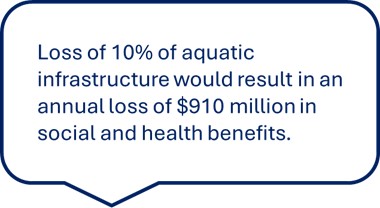
The Report estimated the loss of 10% of aquatic infrastructure in Australia would result in an annual loss of $910 million in social and health benefits.
Background
Across Australia, there are 2,103 publicly accessible aquatic facilities, including outdoor pools, aquatic centres and swim schools. During 2024, these facilities received more than 421 million visits, providing vital opportunities for physical activity, community engagement and skill development. According to RLSA these facilities are critical for urban centres and rural and regional areas, where they serve as anchors of community life and access to safety education, generating $6 million in annual social value per facility.
Benefits Generated by Pools
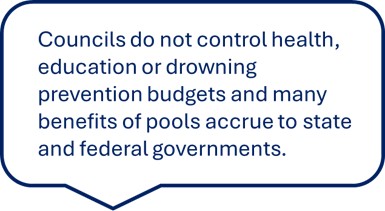
While councils are responsible for the provision and operation of many public swimming pools, they do not control the budgets associated with health, education or drowning prevention. It should therefore be recognised that a significant proportion of the benefits generated by aquatic facilities accrue to other levels of government, rather than directly to local government.
Public swimming pools contribute to preventative health outcomes, improved physical activity, reduced chronic disease risk and enhanced mental wellbeing, which deliver downstream benefits to state and federal health systems through reduced demand for acute and long-term care. Similarly, learn-to-swim and water-safety programs delivered through council facilities underpin broader drowning prevention and public safety outcomes, reducing risks that would otherwise require intervention by emergency services and health agencies.
Aquatic facilities also support education and child development outcomes through structured programs, school-based use and skill development, benefits that align closely with state education objectives but are delivered using local government infrastructure.
As a result, councils often bear a disproportionate share of the capital and operating costs associated with aquatic facilities, while a substantial share of the benefits are realised outside council budgets. This creates a structural misalignment between who pays and who benefits, which should be explicitly acknowledged when assessing value for money, long-term sustainability and appropriate funding responsibilities.
Recognising this misalignment strengthens the case for shared accountability and co-investment across all levels of government and reinforces the need to assess aquatic services not solely on council financial performance, but on their contribution to broader public health, safety and social outcomes.
Public Value
The local government spend on aquatic facilities and programs generates public value benefits in the form of improved health outcomes, enhanced safety, stronger social connections and avoided downstream costs to other public systems.
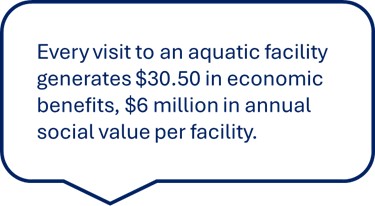
The recent report by RLSA found the aquatic industry contributes $12.8 billion annually in health, social and economic benefits to Australia. Every visit to an aquatic facility generates $30.50 in economic benefits. RLSA found there is a $5.46 social return on investment for every dollar spent on aquatic facility operations.
Service Reviews
Councils facing increasing financial pressure from constrained revenue growth and rising costs associated with the operation and repair of ageing aquatic facilities are undertaking service reviews to determine future service levels and asset requirements.
These reviews typically examine current and projected levels of service, utilisation patterns, operating costs, asset condition, compliance risks and future capital requirements. Such reviews are increasingly necessary to balance community expectations for access to aquatic services with councils’ obligations to manage risk, ensure value for money and maintain financial sustainability over the long term.
Review Results
Aquatic service reviews rarely start with a blank sheet of paper. They are typically undertaken late in the asset lifecycle, under financial and compliance pressure, and within narrow institutional constraints. As a result, the range of feasible outcomes is often limited before the review even begins.
Many of the service reviews have resulted in:
- reduced levels of aquatic service
- “make do” repairs to extend asset useful life
- pool replacement as part of developing an integrated recreation and leisure facility
- do nothing for now – too hard
- pool closure – the asset is unsafe, beyond repair and the council has insufficient funds.
Many aquatic service reviews have resulted in constrained outcomes because councils are operating within a structurally limited decision space shaped by asset condition, financial capacity and governance constraints.
The Problem
The RSLA found that a modest pool costs more than $10 million to build. Integrated recreation and leisure facilities with a pool cost many times more. Most councils, large and small, do not have the funds to absorb the cost of asset replacement and will be relying on government grants.
If the challenge facing public swimming pools were simply a lack of money, then additional grants or one-off capital injections would be sufficient. The evidence shows this is not the case. The scale of asset renewal required, the structural limitations of small catchments, workforce constraints, compliance burdens and long-term operating costs mean that money alone cannot resolve the problem.
Recommendations and Advocacy
Aligned with this thinking, the RLSA’s State of Aquatic Facility Infrastructure in Australia Report recommended the following actions:
- Establish a National Public Pool Investment Program
- Develop a National Public Pool Planning Framework
- Strengthen Workforce Protections & Professional Development
- Implement National Sustainability Standards for Aquatic Facilities
Councils should support RLSA’s recommendations and advocate for state and federal governments to formally recognise public swimming pools as essential public health and safety infrastructure, not discretionary local amenities.
The key step would be to establish a statewide or regional planning framework that defines where pools should be located and what role they play. There also needs to be recognition that not every municipality can or should operate a standalone pool facility. The provision of aquatic facilities needs to be integrated with health, education, sport and emergency management policies and programs. Without this approach, funding decisions will remain fragmented and reactive.
Local government advocacy should seek policy settings that:
- enable and encourage cross-municipal planning and delivery;
- incentivise councils to collaborate regionally;
- allow facilities to be planned based on functional catchments, not municipal boundaries.
Funding without regional coordination risks duplicating infrastructure and locking in inefficiency.
Years of experience across the country have shown that capital grants alone do not address the long-term sustainability of aquatic services. Councils should advocate for operating subsidies tied to public health and water safety outcomes. This shifts the conversation from “closing funding gaps” to co-funding public outcomes.
Councils should argue for shared accountability, where they deliver local infrastructure and access while state and federal governments contribute funding and policy support where success is measured in health, safety and equity outcomes, not cost recovery.
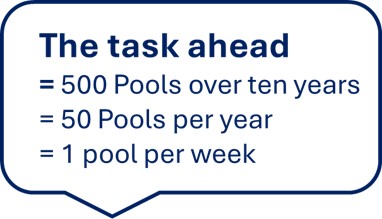
Replacing hundreds of pools cannot be managed through isolated grants one project at a time, one council at a time. The aim is to position council advocacy around system design, roles and outcomes. This will strengthen councils’ strategic credibility and invite governments into partnership rather than rescue.
Advocacy Position
The challenge facing public swimming pools is not simply a funding gap. It is a system design issue involving asset renewal, operating sustainability, public health outcomes and regional equity. Sustainable solutions require coordinated regional planning, shared accountability and long-term policy alignment across all levels of government.
Conclusion
Funding is necessary, but it is not sufficient. Without changes to planning frameworks, service models, accountability and intergovernmental roles, additional funding risks repeating the same unsustainable patterns on a larger and more expensive scale.
The opportunity now is for councils to lead a more mature conversation – one that positions aquatic infrastructure as shared public health and safety infrastructure, requiring shared responsibility and coordinated action.
About Ravim RBC
Ravim RBC is a strategic consultancy assisting councils around Australia with service planning and conducting service reviews. Since 2014 our consultants have been shaping council services to align with community needs and expectations and preparedness to pay.

0 Comments