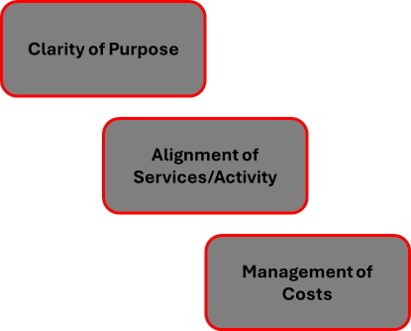
In the commercial sector, the way financial sustainability is approached can translate effectively to local government if applied thoughtfully. Many contemporary public-sector management frameworks follow a similar sequence:
- first understanding purpose
- then aligning services to that purpose, and
- finally ensuring the cost base is sustainable.
In commercial organisations, financial sustainability rarely begins with revenue. It usually begins with clarity of purpose and disciplined management of the cost base. Businesses typically ask three fundamental questions:
- Why does the organisation exist?
- What products or services should it provide to fulfil that purpose?
- What does it cost to deliver those products or services sustainably?
Only after these questions are addressed do businesses determine the pricing required to support those activities. A similar logic can be applied to local government.
Confirmation of Purpose
Councils exist to provide good governance, ensure the effective delivery of services and infrastructure, and make decisions that promote the economic, social and environmental wellbeing of their communities.
As the level of government closest to the community, councils have the responsibility for planning, delivering and maintaining local infrastructure and services that support everyday community life. Councils are expected to plan strategically for the future of their municipalities, manage public assets responsibly, and engage with their communities to understand priorities and aspirations.
Through these roles, local government contributes to the long-term sustainability, liveability and resilience of local communities while supporting the broader public policy objectives of the state.
Over time the range of services delivered by councils often expands in response to changing community expectations, legislative requirements and political priorities. Without periodic review, service portfolios can grow beyond the financial capacity of the organisation.
A clear articulation of purpose allows councils to distinguish between:
- core responsibilities – such as roads, waste management, drainage
- regulatory services – such as health, planning and building
- activities that may be discretionary or better delivered through other levels of government or community organisations.
Alignment of Services
In commercial terms, alignment of services with community needs and expectations is equivalent to ensuring products meet customer demand. For councils, this involves understanding what services communities genuinely value and the standards at which those services should be delivered. Importantly, this process should also consider the community’s willingness and capacity to pay, as this ultimately determines what level of service can be sustained over time.
Structured service planning and service reviews are useful tools in this context. They allow councils to examine each service area systematically, identify demand drivers, define service levels and evaluate alternative delivery models.
Management of Costs
Once councils have clarity about which services they provide and the standard at which they are delivered, attention can turn to the efficiency with which those services are produced. Cost management may involve improvements in operational efficiency, shared services with neighbouring councils, revised service delivery models, or rationalisation of under-utilised assets and facilities.
Importantly, cost management in this context does not simply mean reducing expenditure. It means ensuring that resources are directed toward the services that matter most to the community, while eliminating inefficiencies or activities that no longer align with council priorities.
Service Planning
When these three elements (purpose, service alignment and cost management) are addressed together, councils are better positioned to develop long-term financial plans that are realistic and sustainable.
For many councils, particularly those operating under revenue constraints such as rate capping, this type of structured approach could provide a pathway to restoring financial balance. Rather than focusing solely on short-term budget adjustments, councils can use service planning to reshape their service portfolios and cost structures in ways that better reflect their financial capacity.
Strategic Clarity
In this sense, applying commercial disciplines to local government does not imply adopting a purely profit-driven model. Rather, it involves adopting the same strategic clarity that successful organisations use to ensure their activities remain aligned with their purpose, their customers and their available resources.
About Ravim RBC
Ravim RBC is a strategic consultancy assisting councils around Australia with service planning and conducting service reviews. Since 2014 our consultants have been shaping council services to align with community needs and expectations and preparedness to pay.



0 Comments